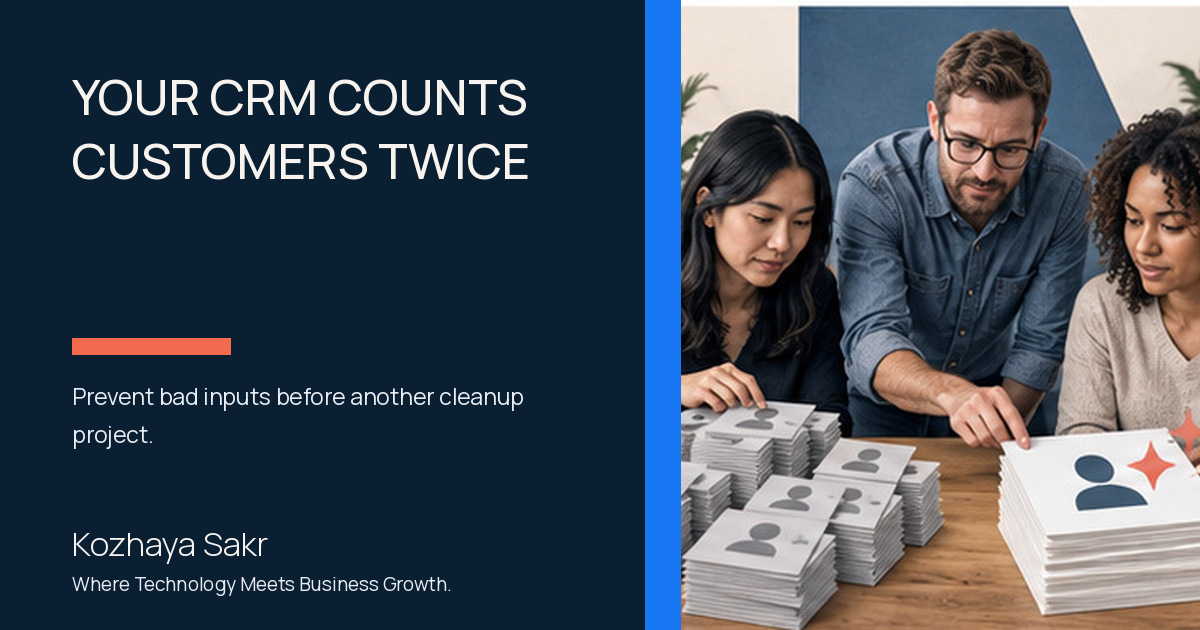
Define record ownership and unique identifiers, prevent bad inputs, merge with survivorship rules, and measure data quality continuously instead of running occasional cleanups. The recurring audience question, How do we stop duplicate and outdated CRM data from corrupting reports?
usually appears after money, time or trust has already been spent.
This guide treats Reddit and Quora as sources of recurring language and practical anxiety, not as representative statistics. Platform and technical claims are checked against authoritative guidance. The diagnostic and implementation recommendations are independent analysis for business use.
The objective is a decision that improves the real customer or operating outcome, not another layer of activity or a more impressive dashboard.
Duplicates are a process symptom
Duplicate records often enter through forms, imports, integrations, manual creation and inconsistent identifiers. Cleaning them without fixing those entry points creates a temporary improvement. First map every system that creates or updates a customer record.
Define what makes a person, company and opportunity unique. Email can help identify contacts but is not sufficient for shared addresses, changes or missing values. Company domains, normalized phone numbers and internal IDs may need to work together.
Merge with explicit survivorship rules
Decide which source wins for name, consent, lifecycle stage, owner, address and last activity. Preserve audit history and never overwrite a valid opt-out with a more recent marketing import. Test merges on a sample and maintain a rollback path.
Assign data owners by object and field. Required fields should support real decisions, not collect information because the software allows it. Validate formats and restrict free text where controlled choices improve consistency.
Turn hygiene into a monitored loop
Track duplicate rate, missing critical fields, stale records, bounced emails, unassigned leads and integration failures. Review exceptions weekly and systemic causes monthly. Make it easy for frontline teams to report a bad record without creating a parallel spreadsheet.
Reliable CRM data improves customer experience as well as reporting: fewer repeated questions, fewer duplicate messages and clearer ownership. AI and automation should be added only after the underlying identity and consent data can be trusted.
A practical thirty-day implementation plan
In week one, document the baseline. Capture the current customer journey, responsible people, tools, costs, permissions and the outcome that should occur. Preserve screenshots or exports before making changes. A reliable baseline prevents normal variation from being mistaken for improvement and makes later decisions defensible.
In week two, speak with three to five people closest to the problem, including someone experiencing it and someone responsible for the downstream result. Ask where they became uncertain, what they had to repeat, which information was missing and what they expected to happen next. Compare those accounts with analytics, system records and support evidence.
In week three, choose one intervention consistent with the article’s core recommendation. Name an owner, a budget, a risk limit and a success threshold before launch. Keep the change narrow enough to interpret. Where safety requires several controls to change together, document that limitation rather than claiming a perfect experiment.
In week four, review quantity and quality together. Did the change improve a qualified conversation, completed task, accurate record, retained customer, resolved request or commercial outcome? Did it create new privacy, accessibility, security or support costs? Decide to adopt, adjust, retest or stop, and record the reasoning.
Common mistakes to avoid
The first mistake is treating community advice as universal proof. A Reddit or Quora post reveals a real person’s problem and may suggest causes, but the business must validate those hypotheses against its own customers, systems and economics. Recurrence justifies investigation; it does not establish one remedy.
The second mistake is optimizing the easiest visible metric. More sends, clicks, leads, app downloads, records or automated messages can look productive while the customer outcome deteriorates. Pair every activity measure with a consequence measure and define failure signals before the test begins.
The third mistake is buying software before clarifying ownership. Every improvement needs someone accountable for customer impact, data quality, permissions and follow-up. Technology can accelerate a sound process, but it can also scale confusion and make an exception harder to interrupt.
Finally, avoid permanent conclusions from short tests. Seasonality, small samples, sales cycles and technical outages can distort results. Preserve the baseline, annotate material changes and repeat high-stakes tests when justified.
Questions for the next management review
Bring the problem into the next review as a decision, not a status update. Ask five questions: What outcome are we protecting? What evidence shows where the first failure occurs? Which assumption are we testing? Who owns the change and its risks? What result would make us continue, revise or stop? These questions keep discussion away from blame and toward an accountable operating choice.
Also examine the customer’s alternative. People do not compare the experience only with your previous version; they compare it with doing nothing, calling a competitor, using another channel or abandoning the task. A technically successful workflow may still lose if it asks for too much information, creates uncertainty or fails to explain the next step. Test the complete experience on a real phone and with someone who did not design it.
Finally, calculate the cost of maintenance. Every campaign rule, integration, profile, model, form and data field creates future work. Name who will monitor it, how failures will be detected and how quickly a customer can reach a person. If the organization cannot maintain the solution, reduce the scope before launch. A smaller process that remains accurate is more valuable than a sophisticated system that quietly decays.
Technology must serve the business objective
From the Kozhaya Sakr Digital perspective, the durable advantage is not another tool or tactic. It is the ability to connect technology and marketing with a clear customer need, an accountable process and a measurable business objective. Diagnose first, intervene carefully and keep only what creates trustworthy value.