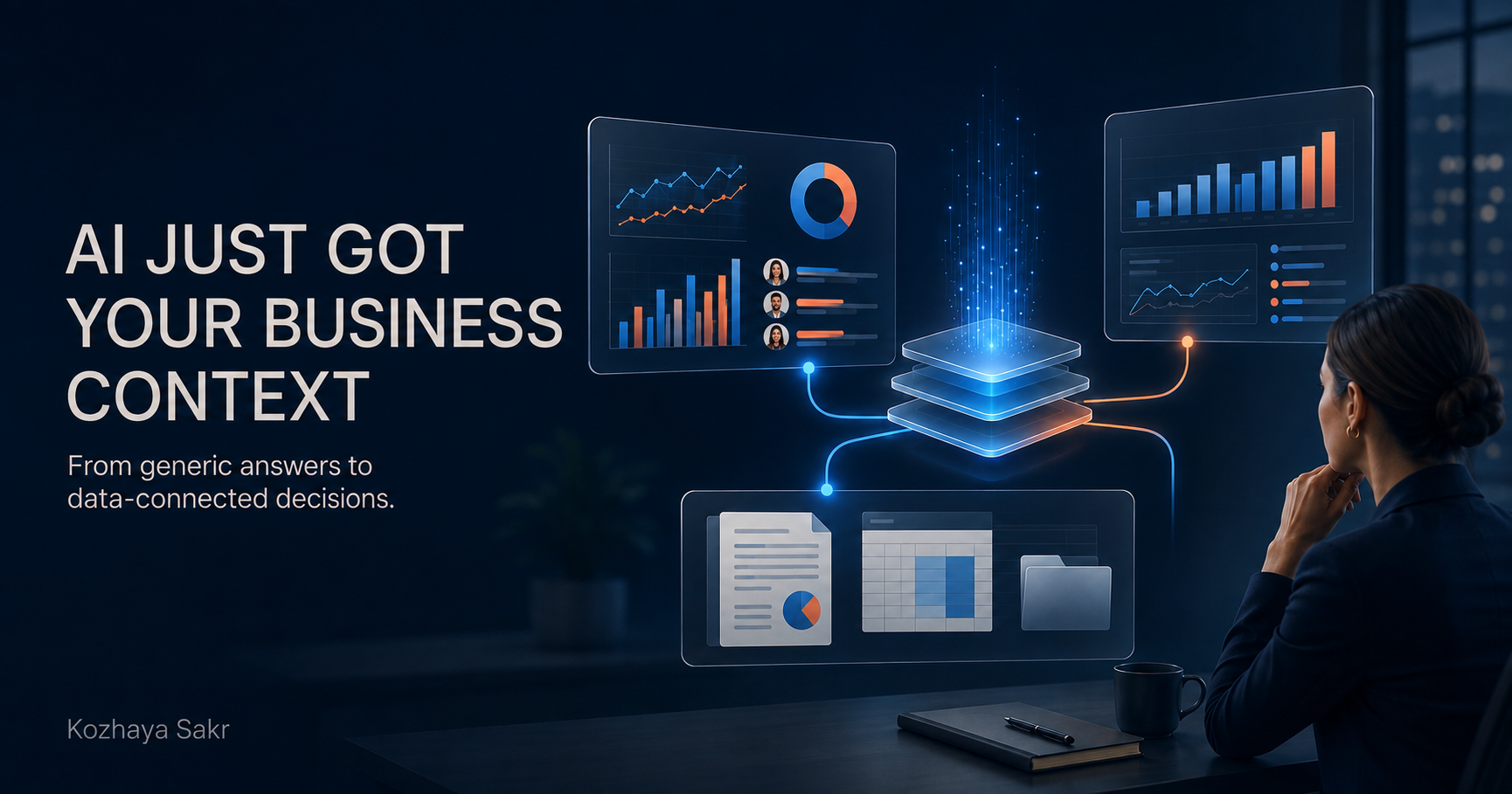
Artificial intelligence is becoming more useful to businesses for one important reason: it is beginning to understand their operational context.
On August 19, 2026, Meta announced new Meta AI capabilities designed for small businesses. Instead of relying only on information manually entered into a prompt, Meta AI can now work with professional Facebook and Instagram accounts, Meta advertising campaigns and selected Google Workspace services.
According to Meta’s announcement, businesses can use these connections to analyze content performance, review advertising results, compare their activity with similar brands and prepare reports, presentations, documents and spreadsheets.
This represents a meaningful shift from generic AI assistance toward context-aware business support. However, access to more data does not automatically guarantee better recommendations—or better commercial decisions.
What has changed?
Most businesses currently use generative AI by describing a situation, copying information into a conversation and asking for advice.
The quality of the response therefore depends heavily on how much context the user provides. If important information is missing, the answer may sound convincing while remaining too general to be commercially useful.
Meta’s new approach reduces part of this limitation by allowing Meta AI to work directly with several sources of business information.
These can include:
- Engagement data from professional Facebook and Instagram accounts
- Meta advertising performance
- Public information about comparable brands
- Selected Google Workspace information
- Documents, spreadsheets and presentations
- Recurring business reports and reminders
A business could, for example, ask which types of Instagram content performed best during the previous month. It could then request recommendations and schedule a recurring performance report.
Similarly, an advertiser could ask Meta AI to analyze the previous 90 days of campaign activity, identify common characteristics among successful advertisements and prepare a presentation for the marketing team.
Meta says the capabilities are available through Meta AI on the web, mobile application and its new desktop experience. Availability may nevertheless differ by account, market and product rollout.
Why business context matters
Generic AI tools can produce ideas quickly, but ideas are not the same as business intelligence.
A recommendation becomes more valuable when it is based on the company’s real audience, content history, advertising performance and commercial environment.
For example, an AI assistant might normally recommend that a company publish more short-form video because video is popular across social platforms. A context-aware system could provide a more relevant conclusion by examining whether that company’s videos actually generated reach, qualified inquiries, website visits or conversions.
This moves the conversation from:
What normally works on Instagram?
to:
What has worked for this business, with this audience, during this period—and what should be tested next?
That difference is commercially significant.
It could allow smaller businesses, which may not have dedicated analysts or large marketing departments, to access faster and more structured performance analysis.
The commercial opportunity
The immediate opportunity is efficiency.
Marketing teams often spend considerable time exporting data, combining spreadsheets, preparing reports and explaining business context to separate tools. Bringing this information into one environment could reduce part of that repetitive work.
Faster performance reporting
Meta AI could help summarize organic and paid performance and convert the findings into a presentation or spreadsheet.
Earlier identification of patterns
The system may help identify which audiences, formats, messages or creative approaches are producing stronger results.
Better preparation for decisions
Managers could receive an initial analysis before reviewing performance with their marketing team or agency.
More consistent monitoring
Recurring reports and reminders could make it easier to follow performance without rebuilding the same analysis every week.
However, these advantages should be assessed against real business outcomes. Saving time on reporting is useful, but only if the information is accurate, relevant and connected to the company’s objectives.
Engagement is not the same as business performance
One of the main risks is confusing platform performance with commercial success.
Meta AI may be able to identify which post generated the most engagement or which advertisement achieved the lowest cost per click. But those figures do not necessarily reveal which activity generated the best customers, strongest profit or highest long-term value.
A highly engaging post may produce no qualified leads. A low-cost advertisement may attract people who never purchase. A campaign with a higher acquisition cost may bring customers who remain loyal for years.
Businesses should therefore connect AI-supported platform analysis with broader commercial information such as:
- Qualified leads
- Sales and revenue
- Profit margins
- Conversion rates
- Customer acquisition cost
- Repeat purchases
- Customer lifetime value
- Retention
AI can help explain what is happening inside a platform. Management must still determine whether that activity supports the company’s wider business objectives.
Privacy and data-governance considerations
The more context an AI system receives, the more carefully access must be managed.
Connecting professional accounts, advertising data, emails or business documents may expose commercially sensitive information. Before enabling these connections, companies should understand which information is being accessed, who can use the system and how the provider handles submitted data.
Axios reported that businesses should consider how information shared through connected accounts may be used under Meta’s applicable policies. Axios also noted the availability of an Incognito Mode intended to provide additional protection for certain conversations.
That does not mean businesses should automatically reject the technology. It means adoption should be governed rather than casual.
Companies should consider:
- Connecting only the accounts required for a defined task
- Reviewing permissions before authorizing access
- Avoiding unnecessary confidential or personal information
- Establishing internal rules for acceptable AI use
- Assigning responsibility for checking generated reports
- Reviewing access when employees or agencies change
- Confirming applicable privacy, contractual and regulatory requirements
Sensitive financial, legal, employee or customer information should not be connected simply because the integration is technically available.
A practical way to test the new capabilities
Businesses should begin with one limited and measurable use case.
A suitable pilot could be a weekly advertising-performance report.
First, define the question clearly. For example:
Which campaigns generated qualified inquiries during the previous four weeks, and which audience, message and creative patterns should be tested next?
Then determine which information the system requires. Avoid connecting unrelated accounts or documents.
When the report is generated, compare it with the original platform data and internal business results. Check whether the system has interpreted the metrics correctly and whether its recommendations make commercial sense.
Finally, measure the value of the process:
- Did it reduce reporting time?
- Did it identify a useful pattern?
- Did the recommendation improve performance?
- Was human correction required?
- Did the benefit justify the level of data access?
Only after a successful controlled test should the business expand the system to additional workflows.
AI should support judgment—not replace it
Meta AI’s new small-business capabilities demonstrate where business technology is heading.
AI systems are becoming more connected to the information companies use every day. This can make their output faster, more personalized and potentially more actionable.
But the strategic responsibility remains human.
An AI tool does not fully understand a company’s financial pressures, internal capabilities, customer relationships, reputation or long-term priorities. It can analyze available information, but it cannot assume accountability for the decision.
The strongest approach is therefore not to ask AI to run the business. It is to use AI to understand the business faster, reduce repetitive work and prepare better-informed decisions.
Technology and marketing create meaningful value when they operate inside a clear commercial system.