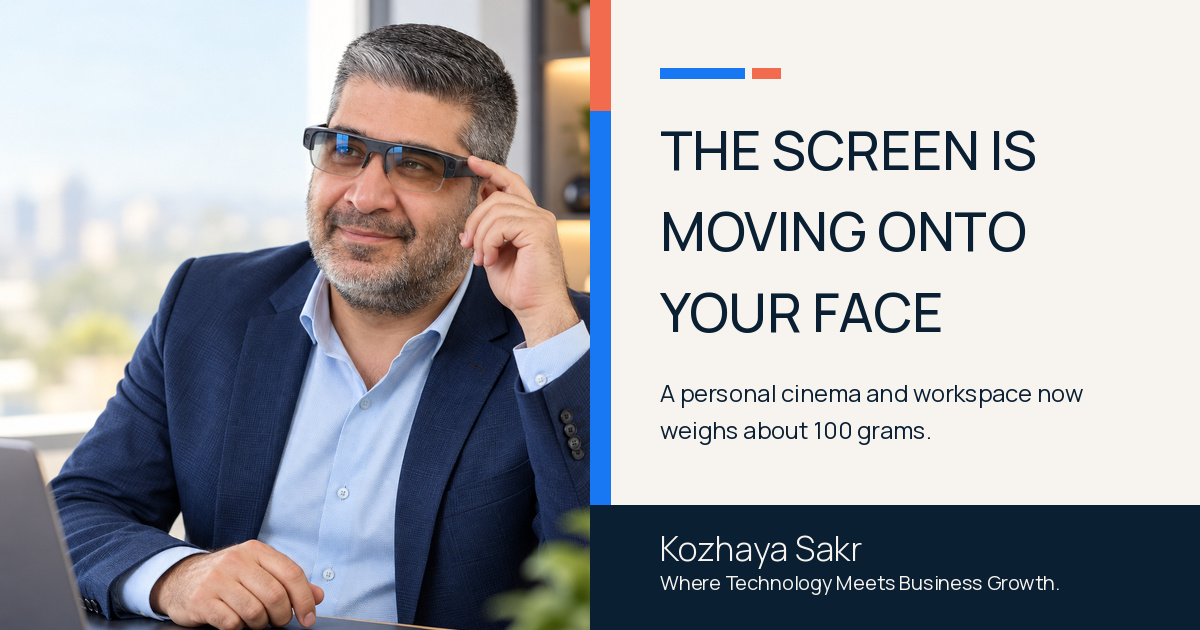
Meta’s new VR glasses point to a future in which a large personal screen no longer lives on a desk or in a bulky headset. The announcement is genuinely interesting, but the product is not available yet and its headline capabilities remain company claims until independent reviewers can test comfort, battery life, privacy behavior and everyday reliability.
What Meta announced and when
Meta introduced Meta VR Glasses at its Connect event on September 23, 2026. The company’s product announcement was first published that day and updated on September 24. Meta says the glasses weigh about 100 grams, roughly one-fifth of a Quest 3, because processing, battery and storage sit in a separate puck connected by an optical tether.
The published specifications include micro-OLED displays, a stated 5K Infinite Display, 37 pixels per degree, Dolby Vision and spatial audio. Open sides and a passthrough camera are intended to keep the wearer aware of the surrounding room. Meta says the device can present multiple private work screens, turn a flat surface into a keyboard and touchpad, support hand-controlled games and enable photorealistic hologram calls through services such as WhatsApp and Zoom.
The glasses are scheduled to go on sale in spring 2027 for $1,299.99 in the United States. Meta also announced entertainment partnerships and says more than 75 games will be available at launch, with over 100 immersive live sports events planned each year. Those details describe the intended launch proposition, not independently verified performance.
Why ordinary users may care
The human appeal is simple: a private cinema or workspace that fits into something closer to eyewear than a headset. A traveler could watch a film without holding a tablet. A remote worker could open several virtual displays in a small room. A sports fan could choose an immersive viewpoint that a television cannot reproduce.
That convenience also creates new questions. One hundred grams is light for VR but still much heavier than normal eyeglasses. The compute puck and tether reduce facial weight but add another object to carry. Comfort over several hours, prescription options, motion sensitivity, heat, battery endurance, visual clarity for different users and social acceptability in public will matter more than stage demonstrations.
The commercial shift is bigger than one device
If glasses become a credible place to work, watch and communicate, businesses gain another customer interface. Media companies can design spatial viewing experiences. Sports rights holders can sell premium virtual access. Software teams can rethink dashboards and collaboration for a private, movable workspace. Retailers and educators can test immersive demonstrations or guided training.
The mistake would be to translate an existing website or advertisement directly into a floating screen. Spatial experiences need a specific job to do: show scale, create presence, reduce training risk, improve focus or make remote collaboration clearer. A business should not invest because the format looks futuristic. It should invest only when the format removes a meaningful customer or operational constraint.
Privacy and data cannot be postponed
Wearable displays depend on cameras, microphones, motion sensing and environmental awareness. Reuters reported on September 22 that smart-glasses privacy concerns are already affecting adoption, with users and venues worried about covert recording and bystander consent. That reporting concerns the wider wearable category and earlier camera-equipped glasses, not a finding that Meta VR Glasses have committed the same behavior.
The lesson is still relevant. Before using spatial devices at work or around customers, an organization needs to know what the sensors capture, what stays on the device, what goes to the cloud, who can access recordings or spatial maps and how data is deleted. Employees and bystanders need a visible way to understand when capture is active. Sensitive meetings, clinics, financial discussions and private homes require stricter rules than a public demonstration area.
A practical readiness test for businesses
- Define one valuable use case. State the customer or employee problem, the current cost and why a spatial display is better than a phone, laptop or conventional headset.
- Map the data path. List every camera, microphone, account, cloud service, recording, spatial map and third-party integration involved in the experience.
- Set consent and location rules. Decide where the device may be used, how bystanders are informed and which rooms or activities are off limits.
- Build a small pilot. Test with a representative group for comfort, accessibility, task completion, support burden and actual time saved before buying at scale.
- Plan for platform dependence. Document content ownership, export options, device management, app distribution and what happens if pricing or platform rules change.
- Measure an outcome, not novelty. Compare error rates, learning speed, conversion, satisfaction or productivity against the existing process.
Opportunities, limits and accessibility
The product could make immersive computing more approachable, but the announced price puts it above many mainstream laptops and conventional headsets. Availability begins in 2027, partner content may vary by country and some experiences will require separate subscriptions. Buyers should also wait for independent information about repairability, prescription support, device management and long-session ergonomics.
Accessibility must be designed rather than assumed. Voice, gaze, hand gestures and a virtual keyboard may help some people while excluding others. Captions, contrast, input alternatives, audio controls, motion settings and seated use all need testing. A visually impressive experience that a significant part of the intended audience cannot comfortably use is not a successful customer experience.
What professionals should do next
Most businesses do not need to place an order today. They should identify workflows where privacy, portability or spatial context could create measurable value, then prepare a pilot brief with success criteria and data safeguards. Content teams can begin by learning spatial storytelling; IT and legal teams can define device and consent policies; leaders can set a spending threshold tied to evidence rather than enthusiasm.
Kozhaya Sakr Digital’s practical view is that wearable computing becomes commercially important only when it solves a real problem better than the screen it replaces. Technology and marketing should serve a clear business objective, with trust and human comfort treated as product requirements rather than launch-day disclaimers.
Conclusion
Meta VR Glasses make the post-headset future easier to imagine: a 100-gram personal cinema and workspace priced at $1,299.99 and planned for spring 2027. The opportunity is significant, but the responsible response is measured experimentation. Test the use case, the body, the data and the business result before treating the next screen as inevitable.