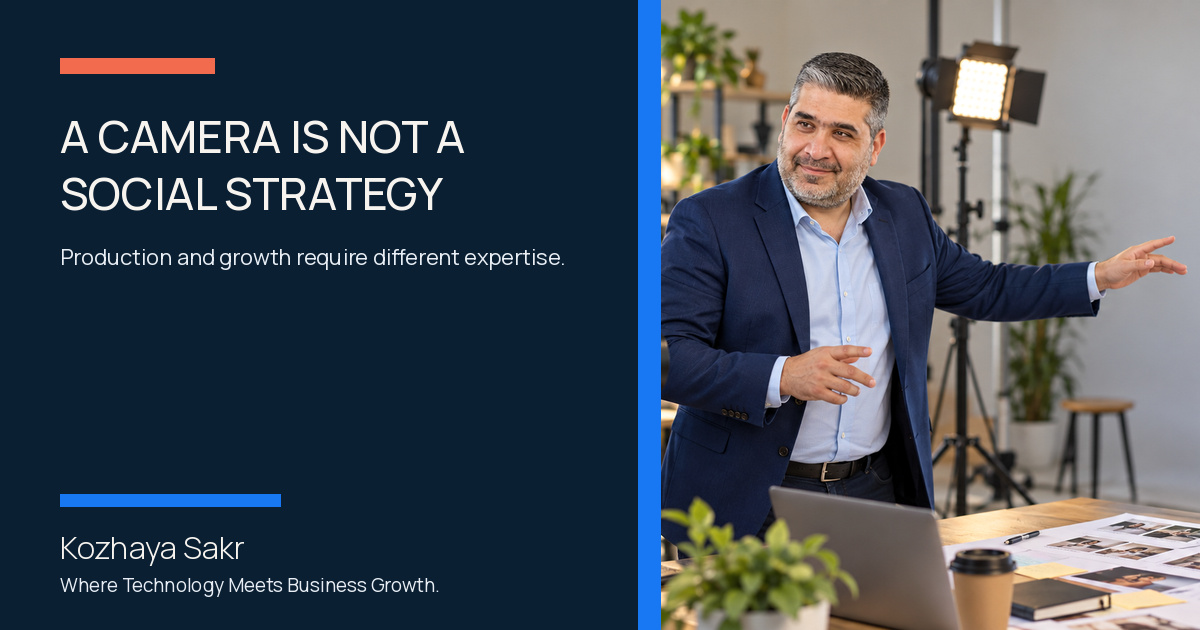
Photography and video production are specialist inputs. Social-media management is an operating discipline. Hire or assign strategy, audience, community, publishing, measurement and commercial accountability explicitly; then connect the right production talent to that plan. The recurring question is: Should a photographer or videographer manage a business’s social media, or does it need a marketing strategist?
This package treats community discussions as qualitative evidence of a recurring need, not a representative survey or popularity ranking. Reddit posts were reviewed beyond their titles where accessible. Quora blocked direct access during research, so only indexed question wording informed topic discovery; no Quora engagement figures or unsupported claims are used.
The useful management response is to replace the broad symptom with an observable decision. Preserve the current evidence, identify the earliest consequential break, improve the smallest meaningful part of the system and judge the result against a customer and commercial objective.
Two professions, two different accountabilities
A photographer is accountable for still-image craft: light, composition, direction, capture and finishing. A videographer adds movement, sound, pacing and production logistics. Those are valuable, demanding disciplines. Neither title automatically includes audience research, positioning, channel planning, community operations, paid distribution or revenue measurement.
A social-media strategist starts with the audience and business objective, then determines what should be communicated, where, in which format, at what cadence and with what evidence. A manager also coordinates publishing, comments, escalation, permissions, reporting and iteration. Some professionals can do both, but the combination must be demonstrated—not assumed.
The problem is not hiring visual talent. The problem is writing a vague brief such as “manage our socials” and silently attaching sales, reputation and growth expectations to a production contract. Ambiguous accountability leaves the business disappointed and the creative professional judged for work outside the agreed scope.
Why good-looking content can still underperform
Visual quality can earn attention, but relevance earns continued attention. A polished video aimed at the wrong audience or built around an internal company message may be admired without changing anyone’s decision. Strategy determines the problem, promise and reason to care before production begins.
Distribution is another discipline. Publishing times, format selection and captions matter less than the larger system: discoverability, recurring themes, creator or partner fit, community response, paid support where justified and continuity to the next customer step.
Measurement completes the role. A strategist must distinguish reach, retention, saves, qualified visits, leads, sales, service questions and brand risk. A production supplier should receive feedback on creative performance, but commercial interpretation needs an owner with access to the wider customer journey.
How to diagnose the staffing gap
List the work actually required for one month: research, planning, scripts, design, shooting, editing, approvals, publishing, community responses, paid campaigns, reporting and optimization. Mark the current owner of each task. Empty cells and overloaded names reveal the real gap.
Review three recent posts from brief to outcome. Ask who selected the audience, defined the intended behavior, approved the message, distributed the asset and interpreted performance. If the answer changes at every stage, process design—not camera quality—is the first problem.
Separate production bottlenecks from strategy bottlenecks. Repeated missed shoots or slow edits need production capacity. Repeated generic ideas, weak offers, irrelevant engagement or unexplained reports need strategic leadership. Many businesses need both, at different levels of intensity.
Inspect incentives. Paying per video rewards asset volume. Paying for account management rewards ongoing coordination. A strategy engagement should reward clarity, learning and business alignment. No contract should promise guaranteed organic reach, because platforms control distribution and audiences make independent choices.
A better team and brief
Name one social lead accountable for the plan. That person may be internal, fractional or agency-based, but needs authority to connect marketing, sales, service and leadership. The lead should brief photographers, videographers, designers, writers and media buyers rather than expecting one craft to replace the system.
Write briefs with five elements: target audience, tension or job, single message, desired next action and proof. Add format and visual direction afterward. This preserves creative freedom while preventing an attractive asset from solving the wrong problem.
Create a monthly learning rhythm. Review the strongest and weakest content by audience quality, message clarity, retention, response and downstream action. Decide what to repeat, change or stop. Do not reduce the meeting to whether views rose or fell.
Protect access and reputation. Use business-owned accounts, role-based permissions, approval paths and a written response policy. The person holding the camera should not automatically hold the passwords, customer complaints or crisis authority.
Limitations, fairness and commercial reality
Small teams may need hybrid professionals. That is reasonable when the scope is explicit and the person can show competence across planning, production and measurement. The answer is not more job titles; it is honest capability mapping and realistic workload.
Do not devalue photographers or videographers by framing strategy as “more professional.” Strong production materially improves comprehension and trust. The commercial mistake is asking any specialist to absorb unrelated responsibilities without time, information, authority or compensation.
Reach can decline even with competent management because audience demand, competition, creative fit and platform distribution change. Expertise improves diagnosis and decision quality; it does not control the platform. Contracts and reporting should reflect that boundary.
A concise decision framework
Ask five questions before approving more budget or technology: What outcome are we protecting? Where does the first verified failure occur? Which assumption are we testing? Who owns the change and its risks? What result would make us continue, revise or stop?
Document the baseline, owner, intervention, limitations and review date in plain language. This creates organizational memory, prevents a new supplier from repeating an abandoned experiment and gives future decision-makers a fair account of why the current approach exists.
How to run the next review
Bring one successful case, one failed case and one ambiguous case to the review. Compare what the customer saw with what the systems recorded and what the team expected. This small evidence set will not prove a universal rule, but it usually reveals whether the next investment belongs in acquisition, experience, operations, governance or measurement.
Agree on the next owner and decision date before the meeting ends. Record dependencies, customer impact, privacy or security concerns, and the conditions that require rollback or specialist advice. A bounded experiment with a clear stop rule is more responsible than an open-ended initiative sustained by activity alone.
Technology must serve the business objective
Kozhaya Sakr Digital’s practical perspective is that the durable advantage is not another metric, tool or fashionable tactic. It is the ability to connect technology and marketing with a real customer need, an accountable operating process and a measurable business objective. Diagnose first, intervene responsibly and keep only what creates trustworthy value.