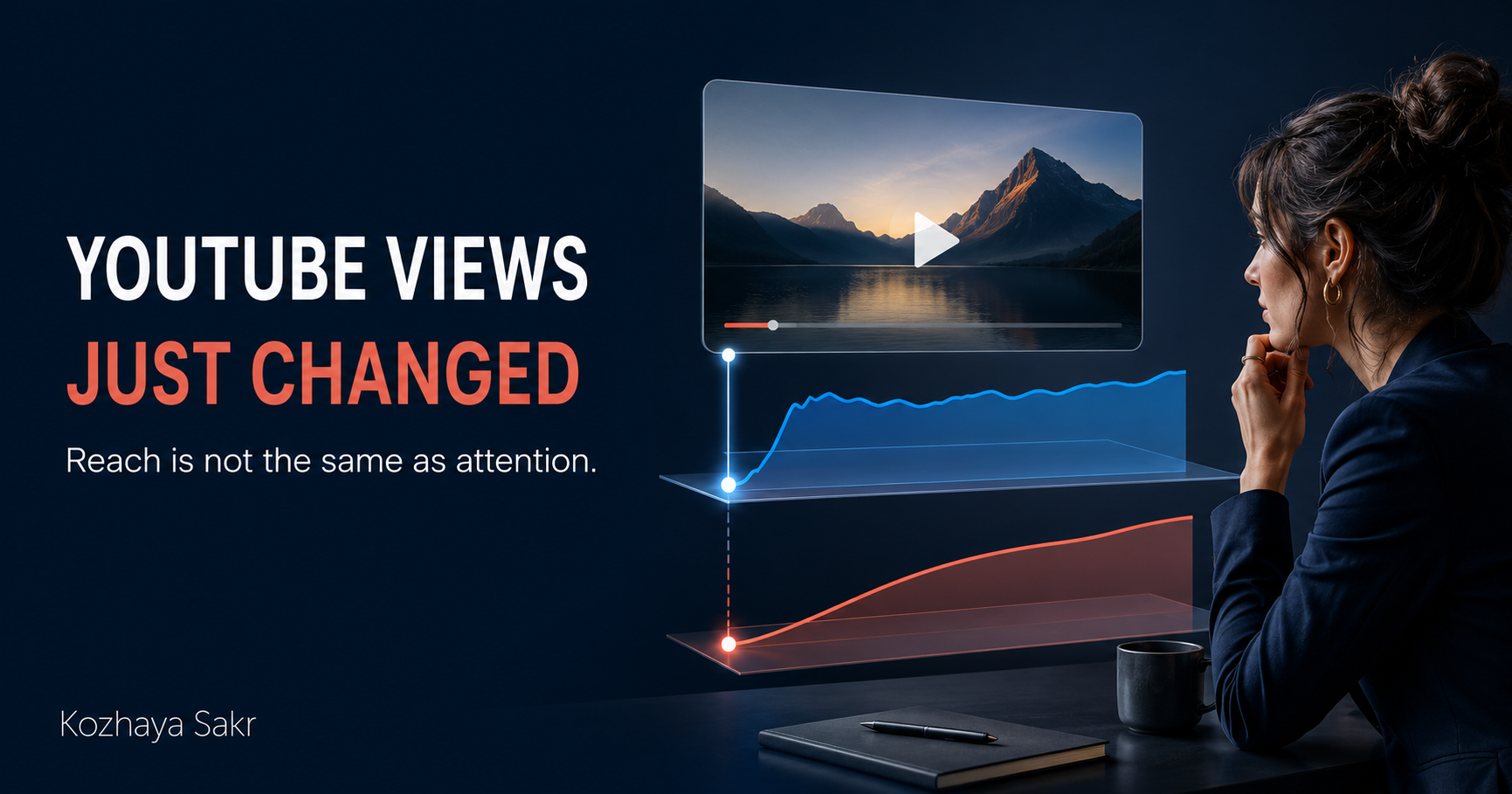
YouTube has changed the meaning of one of its most visible performance indicators.
Beginning August 24, 2026, a public view is counted from the moment a video begins playing, starting with its first frame. The standard applies across Shorts, long-form videos and live streams.
The change gives creators and brands a more consistent measurement of exposure across YouTube’s different formats. However, it also makes an important distinction clearer: a video starting to play does not necessarily mean that it captured the viewer’s attention.
For marketers, the public view count has become a reach indicator that must be interpreted alongside deeper measures of engagement.
What exactly changed?
YouTube previously used different view-counting methods across its video formats. Shorts already used a play-based measurement, while other formats followed different rules.
According to YouTube’s official announcement, the platform standardized its public view metric on August 24. A view is now registered when a video begins playing, whether it is a Short, a conventional video or a live stream.
YouTube says this gives creators a more consistent picture of their exposure across different formats.
The company has not abandoned its deeper performance measurements. Its previous view methodology remains represented through engaged views and watch-time metrics inside YouTube Analytics.
This creates two distinct analytical layers:
- Public views: How often the video started playing
- Engaged views and watch time: Whether viewers continued watching and how much attention the video received
Both measurements are useful, but they answer different questions.
Why public views may grow faster
When a view is registered from the first frame, a video can accumulate public views without requiring the viewer to remain for an extended period.
This means creators and brands may see public totals rise more quickly than under earlier measurement standards. An increase following August 24 should therefore not automatically be interpreted as improved content quality or stronger audience interest.
The video may have reached more people. It may also be benefiting from a broader definition of what qualifies as a public view.
This is not necessarily a weakness in the metric. Exposure is commercially relevant. A brand needs to know whether its content is being placed in front of an audience.
The problem arises when exposure is presented as evidence of attention, persuasion or commercial performance.
Reach is not the same as attention
A person who encounters the first frame of a video is not equivalent to someone who watches the complete message.
Public views answer an important question:
How many times did the content begin playing?
They do not independently answer:
- Did viewers continue watching?
- Did they understand the message?
- Did they visit the company’s website?
- Did they make an inquiry?
- Did the video influence a purchase?
- Did the content generate a qualified business opportunity?
A campaign can produce a large public view count while maintaining weak audience retention. Another campaign may reach fewer people but hold their attention longer and generate more qualified actions.
The second campaign may be commercially stronger, even when its visible view total is lower.
Monetization and eligibility remain separate
YouTube confirms that the change does not affect how creators earn money or qualify for the YouTube Partner Program.
According to its updated content-performance documentation, earnings continue to use engaged Shorts views and engaged watch hours. Program eligibility continues to rely on qualified Shorts views and qualified watch hours.
This separation is significant.
YouTube is effectively distinguishing public exposure from the deeper activity used for monetization and eligibility. Marketers should adopt the same discipline in their reporting.
A higher public view total does not automatically mean higher revenue, stronger engagement or greater commercial value.
Historical comparisons now require context
The change creates a reporting challenge for companies that compare current performance with previous months or years.
A public view recorded after August 24 is not necessarily equivalent to one recorded under an earlier standard. Combining the periods without explanation could produce misleading conclusions.
Marketing teams should annotate August 24, 2026, in dashboards and reports as a measurement change.
When evaluating trends, consider separating results into:
- Performance before August 24
- Performance after August 24
- Engaged views across both periods
- Watch time and retention
- Traffic and conversions generated by video
- Commercial outcomes attributed to the campaign
Year-on-year or month-on-month reporting should clearly disclose the methodology change rather than presenting any resulting increase as purely organic growth.
What marketers should measure now
Public views should remain part of the dashboard, but they should not dominate it.
A useful YouTube performance framework should include four levels.
1. Exposure
Measure public views, impressions and unique viewers to understand how widely the content was distributed.
2. Attention
Review engaged views, watch time, average view duration and audience retention to determine whether people stayed.
3. Response
Measure clicks, website visits, subscriptions, inquiries and other actions that followed the video.
4. Commercial impact
Connect campaigns to qualified leads, sales, customer acquisition costs, revenue or another meaningful business objective.
This structure prevents teams from confusing platform activity with commercial achievement.
Practical actions for businesses
First, update reporting templates. Public views should be labelled as exposure, while engaged views and watch time should appear in a separate attention section.
Second, annotate the methodology change. Every dashboard covering August 2026 should explain that YouTube changed public view counting on August 24.
Third, review benchmarks. Targets based on historical public views may no longer be directly comparable. New baselines should be established after enough post-change data has been collected.
Fourth, examine the opening seconds. A view begins immediately, but attention must still be earned. The first frames should establish relevance quickly without relying on misleading hooks.
Fifth, connect video analytics with business data. A successful video should support a defined objective, whether that is awareness, qualified traffic, lead generation, education or sales.
A better definition of video success
The YouTube update does not make public views meaningless. It makes their meaning more specific.
A public view represents the beginning of exposure. It should not be treated as proof of sustained attention or business impact.
Brands, creators and agencies now have an opportunity to improve their reporting by separating these stages clearly.
Instead of asking only, “How many views did the video receive?” decision-makers should ask:
- How many people encountered it?
- How many stayed?
- How did they respond?
- What business result did the content support?
That is a more demanding measurement system, but it is also a more commercially useful one.
Technology and marketing create real value when metrics are interpreted inside a clear business objective.